
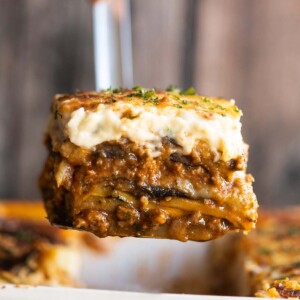
Moussaka is a Greek classic, and here I’ll show you how to make it in the most delicious way possible!
Moussaka is a labour of love, but once you get in the swing of things, it truly couldn’t be easier to make. There are also a fair few different ways to make Moussaka, but today I’ll show you a tasty and authentic way!
Reader, Bea says: ‘Reminds me of home just like my grandma makes !! I love this recipe thank you for capturing the true essence of Greek cuisine ★★★★★’
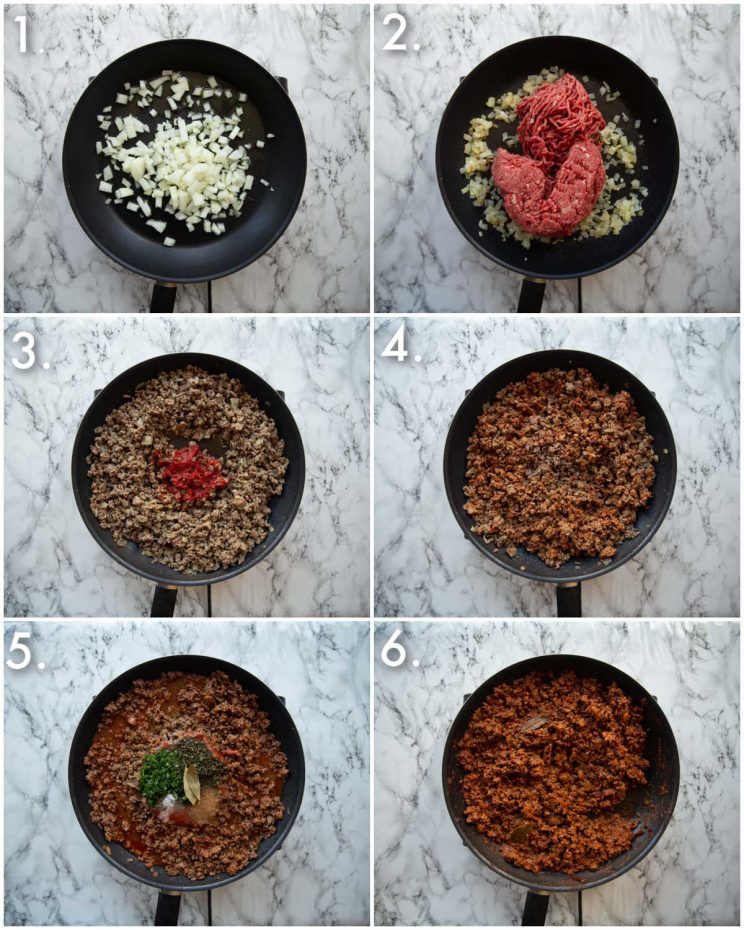
Meat Sauce for Moussaka
Beef vs Lamb
There’s a lot of dispute over what the traditional meat to use in Moussaka is. Most commonly, you’d see lamb or beef being used, but I’ve even read that pork or veal have traditional roots! I’ve personally tried this recipe using beef and lamb, and have settled on beef. In my opinion, it takes on the flavour profile of a Moussaka better, but you can use lamb if you want.
Thick Consistency
The meat sauce for a Moussaka is somewhat similar to a classic ragu/bolognese. One of the main differences is the consistency. Moussaka is known for having distinctive layers, and ensuring your meat sauce has reduced down properly will help create those layers.
Cinnamon
Another distinctive part of a Moussaka’s meat sauce is the use of cinnamon. It’s quite subtle, but it really gives that classic Moussaka flavour. You can use a cinnamon stick, or use ground cinnamon as I’ve done here.
Process shots: fry onion and garlic (photo 1), fry beef (photo 2), add tomato paste (photo 3), fry then add red wine (photo 4), pour in stock and passata then add thyme, parsley, bay leaves, cinnamon and seasoning (photo 5), simmer until thick consistency (photo 6).
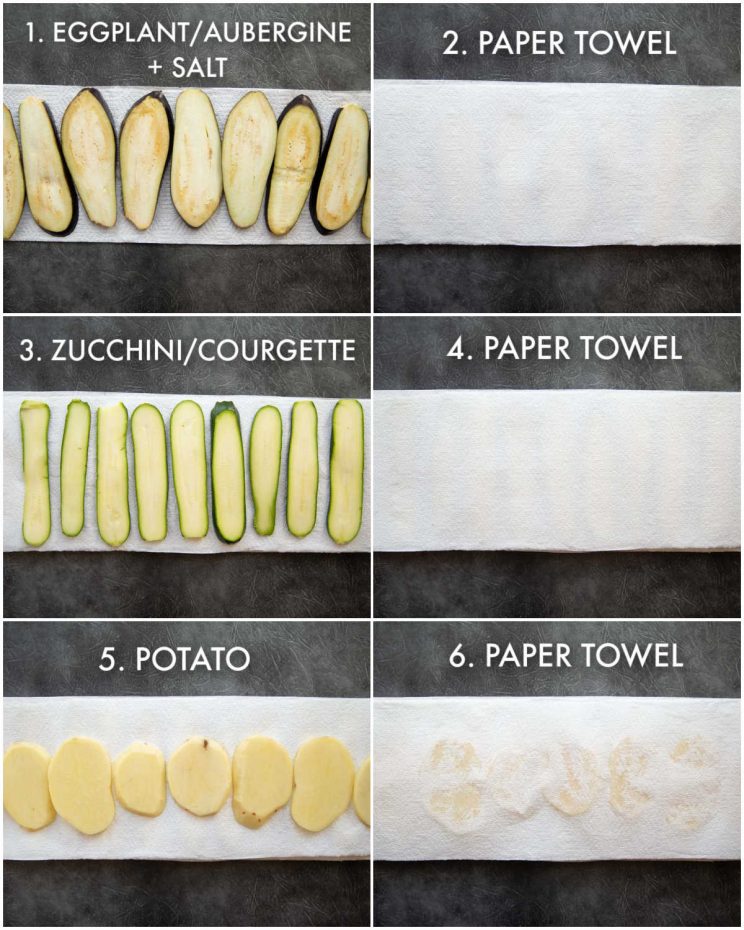
Vegetables in Moussaka
Eggplant/Aubergine
Eggplant in Moussaka is essential. To prepare it, you’ll need to slice then sprinkle with salt and leave to rest. This will not only draw out unwanted moisture but will also remove the bitter taste from the eggplant.
Potato
You could probably get away with just layering with eggplant and still call it a Moussaka, but potato is very widely used. And of course, me being me and this blog being this blog, I highly recommend adding potato. After you’ve sliced the potatoes, I recommend patting them dry to remove unwanted moisture.
Zucchini/Courgette
Not as widely used, but still an authentic addition. Same as above, just pat the slices dry to remove moisture.
You could pat the veg dry with tea towels, but I like to stack them between sheets of paper towel. That way, you can soak them all at once and just leave them until needed.
Recipe Tip #1
Removing the moisture from the vegetables is important whether you bake or fry them. If there’s too much moisture before you fry the veg, it won’t crisp up as well and the oil will spit. If there’s too much before you bake, it will steam and come out too soft.
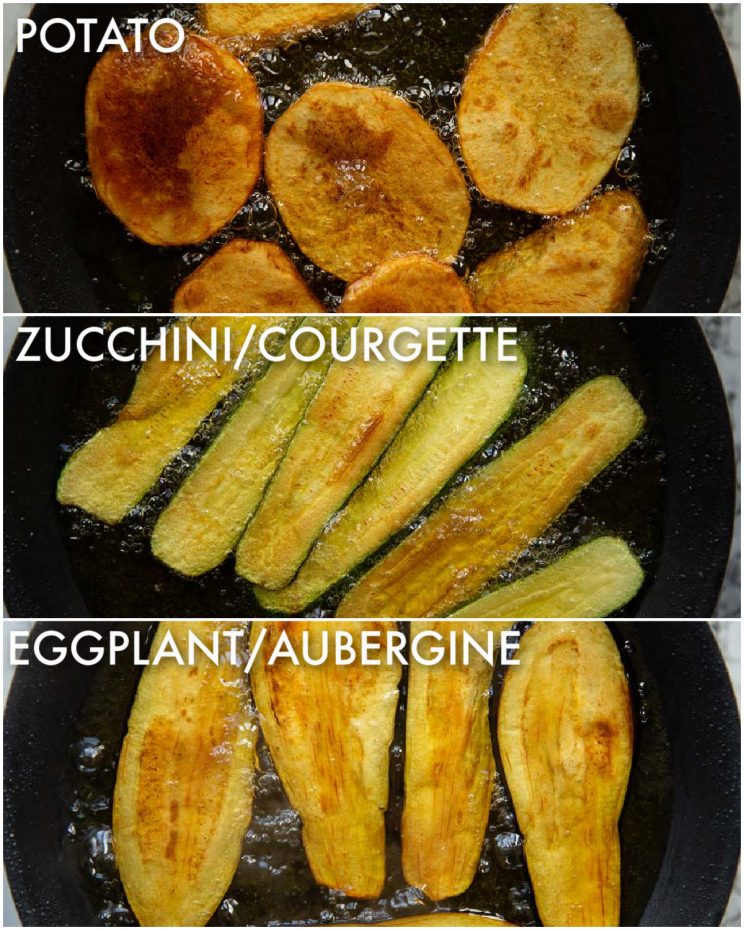
Baking vs Frying
Traditionally, you’d fry the veg, but as times have moved on, so has the cooking method. As such, nowadays it’s just as common to bake the veg. Me? You know I’m not shy of oil around here.
I fry the veg mainly because I’ve always got some leftover pot of oil that needs recycling. That and you do get more of a deeper golden ‘crust’, which offers slightly more flavour.
The obvious downside is the absorption of oil, namely in the eggplant (which is like a sponge!). As such, just make sure you thoroughly pat it all dry with paper towels before you stack the Moussaka. But again, you can definitely bake the veg if you’d prefer.
Recipe Tip #2
Because you’re not frying at a super high temerature, you can use olive oil (which adds more flavour to the veg). Alternatively, for a more neutral flavour, just use veg oil.
Béchamel Sauce for Moussaka
Meat Sauce layer – check
Veg layer – check
The third and final main layer is the béchamel sauce. Again, this is similar to a classic béchamel you’d use in an Italian lasagne, just with a few differences:
- Consistency – Just like the meat sauce, this béchamel is MUCH thicker than the classic. Again, just to ensure it creates a defiant layer that doesn’t seep into the meat sauce.
- Egg Yolk – These help thicken the sauce, but also add a gentle, rich flavour.
- Seasoning – nutmeg and white pepper are a must! The béchamel sauce makes up quite a thick layer, so it’s important that it’s properly seasoned.
What Cheese to use?
Traditionally you’d use Kefalotyri, but realistically, most hard cheeses work well. Here I use Pecorino, but Parmesan works nicely.
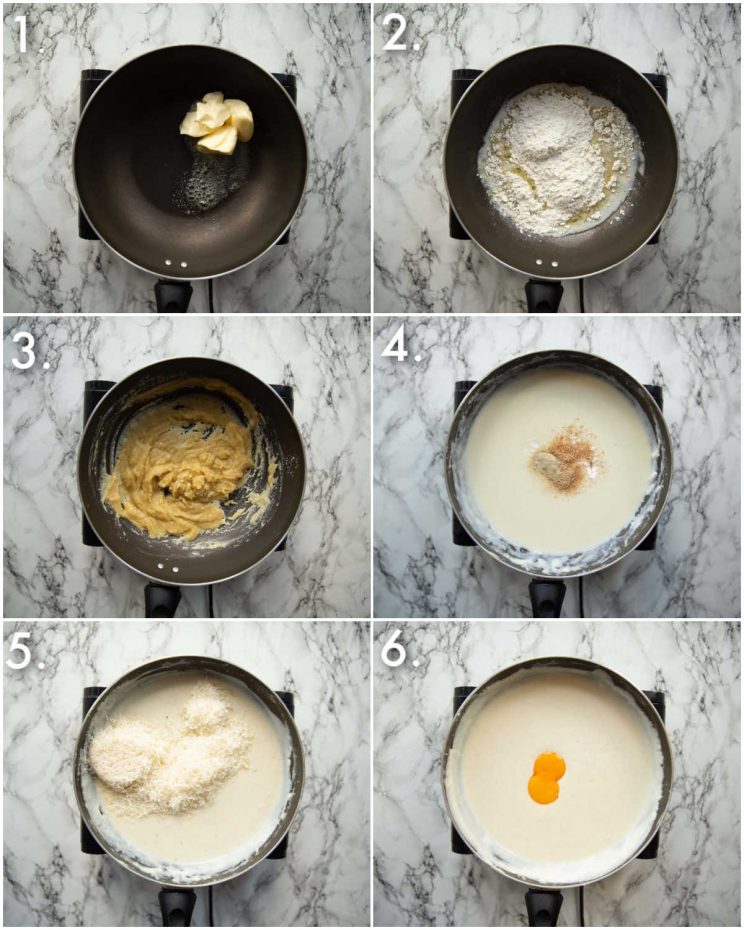
Process shots: melt butter (photo 1), stir in flour (photo 2), whisk in milk (photo 3), add seasoning (photo 4), add cheese (photo 5), stir in egg yolks (photo 6).
Moussaka Layers
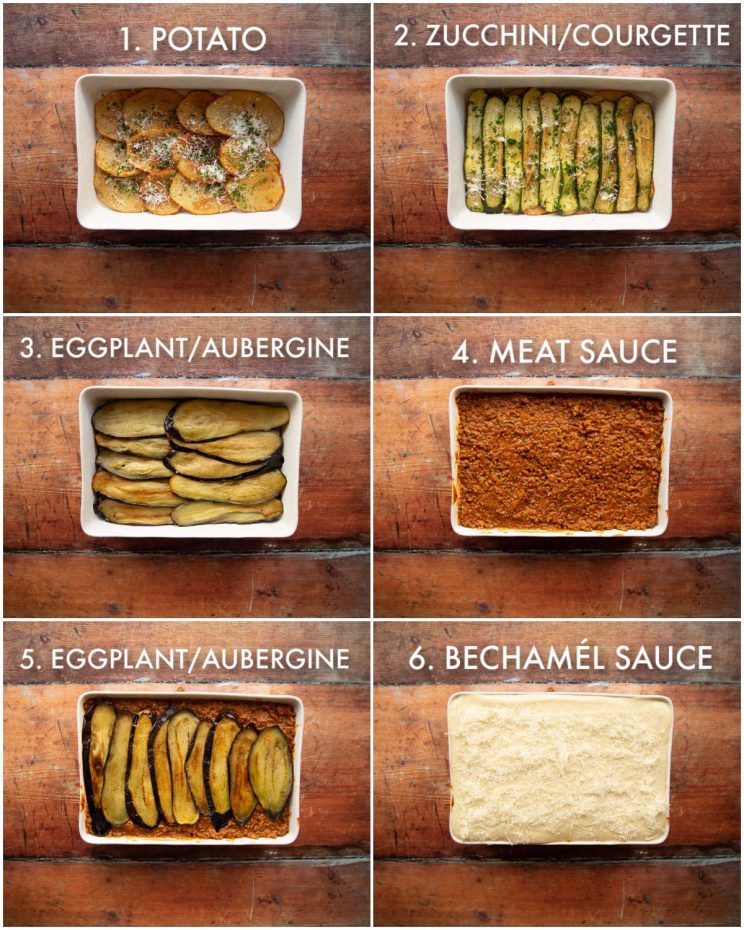
You can stack a Moussaka in various different ways, but you really want to ensure the potatoes are at the bottom, just to create a sturdy base. Then you finish with a nice thick layer of the béchamel. This also ends up going beautifully golden and crispy as it bakes. Here’s how I stack mine:
How to layer a Moussaka
- Potatoes – Sprinkled with cheese, parsley, salt & pepper.
- Zucchini/Courgette – Stacked in the opposite direction to the potatoes. Sprinkled with cheese, parsley, salt & pepper.
- Eggplant/Aubergine – Only use half, sprinkled with salt & pepper.
- Meat Sauce – Ensure this is nice and level/flat.
- Eggplant/Aubergine – Second half stacked in opposite direction to the first layer, seasoned with salt & pepper.
- Béchamel Sauce – Topped with more cheese.
Recipe Tip #3
Overlap the veg as needed, to create a nice, compact moussaka. This will ensure it keeps its shape when you serve, as opposed to spilling over the plate.
Moussaka FAQ
The main thing is to ensure both the meat sauce and bechamel are nice and thick before you stack the moussaka. Resting the moussaka once it’s fresh out of the oven will help it keep its shape too.
If you’ve fried the veg, it’s really important to use paper towels to soak as much excess oil as possible before you stack the moussaka. It’s also important to use lean beef for the meat sauce, otherwise there will be too much excess fat.
I love adding a glug of wine to the meat sauce for a gorgeous depth of flavour. However, you can sub more beef stock if you’d prefer.
How to serve Moussaka
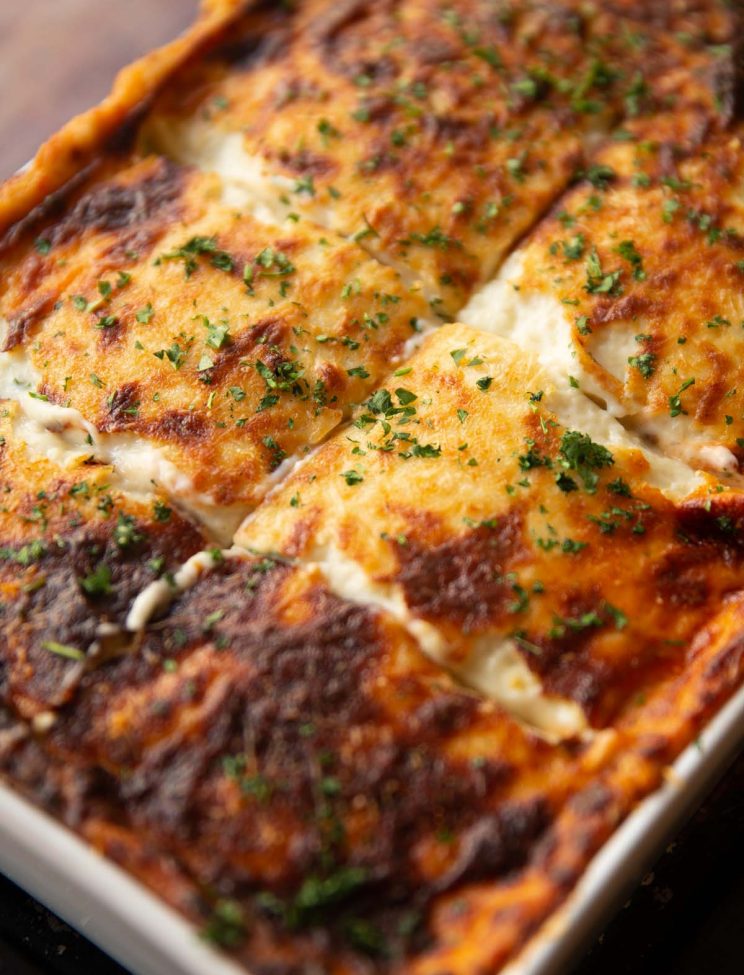
Again, just to reiterate, it’s important to let the moussaka sit before you serve (it’ll stay hot longer than you think). From there, I like to garnish with a good pinch of fresh parsley and carefully slice it into portions.
These days, I actually serve Moussaka at dinner parties, just because it’s such an epic dish. However, it’s perfect to batch and use throughout the week too.
When it comes to what to serve with Moussaka, here are some of my favourites:
- Side salad and crusty bread (or Garlic Bread). Simple and a lighter option.
- Roasted potatoes or boiled baby potatoes if you’re feeling extra carby.
- Go all out and serve with Greek Fries or Greek Roast Potatoes.
- Roasted Broccolini or Garlic Green Beans for some veggie options.
- Plonk a big bowl of Greek Orzo Pasta Salad in the centre of the table.
Alrighty, let’s tuck into the full recipe for this Moussaka shall we?!
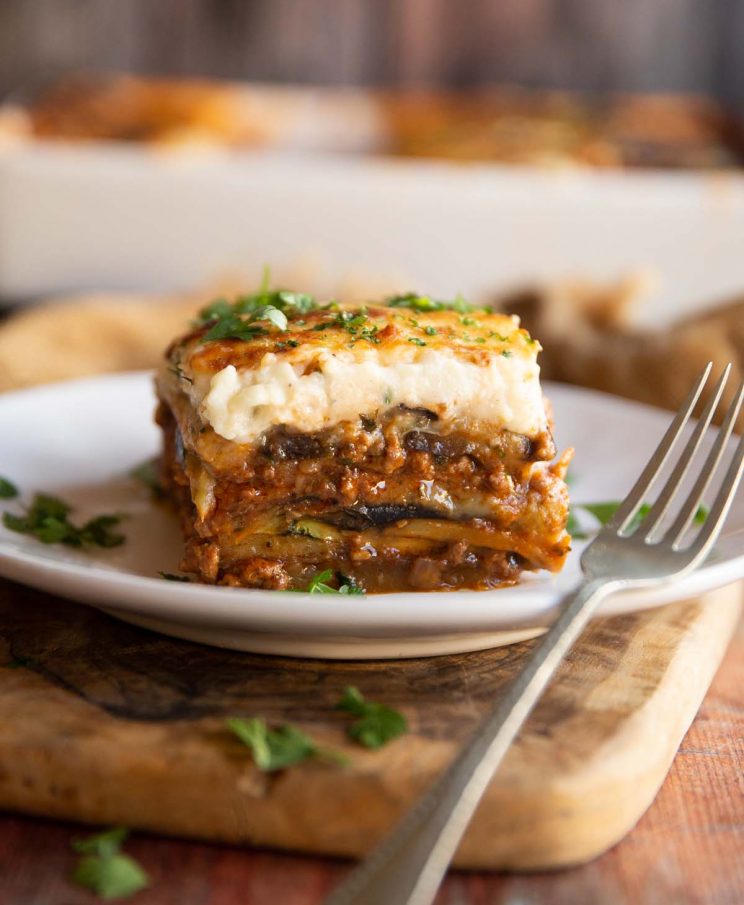
How to make Moussaka (Full Recipe & Video)
Outrageously Delicious Greek Moussaka
Equipment
- Sharp Knife & Chopping Board
- Large Pot or Pan & Wooden Spoon (for meat sauce)
- Good Quality Kitchen Roll/Papers Towel (lots of it – for soaking veg)
- Large Pan & Tongs (suitable for shallow frying veg)
- Kitchen Thermometer (for frying)
- Medium/Large Pot & Whisk (for bechamel sauce)
- Jug (for milk)
- Fine Cheese Grater (for parmesan)
- 8" x 12" Baking Dish (or similar size – for stacking the moussaka)
- Serving Spatula/Spoon
Ingredients
Beef Layer
- 1 tbsp Olive Oil
- 1 large White Onion, finely diced
- 2 cloves of Garlic, finely diced
- 1.6lb / 750g Ground/Minced Beef (preferably fairly lean)
- 2 heaped tbsp Tomato Paste (Tomato Puree in UK)
- 1/2 cup / 120ml Dry Red Wine (can sub more beef stock)
- 1 cup / 240ml Tomato Passata (pureed/strained tomatoes in US)
- 1 cup / 240ml Beef Stock
- 1/4 cup finely diced Fresh Parsley, plus extra to serve
- 1 tbsp finely diced Fresh Thyme Leaves
- 2 small or 1 large Bay Leaf
- 3/4 tsp Salt, or to taste
- 1/2 tsp Sugar
- 1/2 tsp Cinnamon
- 1/4 tsp Black Pepper, or to taste
Béchamel Sauce
- 4oz / 120g Unsalted Butter
- 4oz / 120g Plain Flour
- 4 cups / 1litre Milk, at room temp
- 1/2 tsp Salt, or to taste
- 1/2 small Nutmeg, grated (or 1/4 tsp ground nutmeg)
- 1/4 tsp White Pepper
- 1 cup / 80g freshly grated Pecorino Romano, plus extra to serve (Kefalotiri Cheese is traditional, can also sub parmesan)
- 2 Egg Yolks
Veg Layers (see notes for baking version)
- 2 cups / 480ml Vegetable or Olive Oil, or enough to cover veg in the pan
- 1.6lb / 750g (approx 2 large) Baking Potatoes, peeled & sliced around 1/4"
- 1lb / 500g (approx 2 medium) Zucchini/Courgettes, sliced into approx 1/3" strips (I do lengthways)
- 2lb / 1kg (approx 4 smallish) Eggplants/Aubergine, sliced around 1/3" thickness (I do lengthways but you can make more smaller rounds if you wish)
- few pinches of Parsley & Pecorino (to sprinkle in between layers)
- Salt & Pepper, as needed
Instructions
- Beef Layer: Heat 1 tbsp olive oil in a large pan or pot over medium heat. Add the onion and fry until soft and golden, then add in the garlic and fry for a minute or so longer. Add in the beef and fry until completely browned, breaking it up with your wooden spoon as you go. Stir in the tomato paste and fry for a couple of mins, then pour in the wine. Deglaze the pan if needed, then pour in the passata and beef stock. Add in the parsley, thyme, cinnamon, salt, sugar, pepper & bay leaf and give it a good stir. Keep on a gentle simmer for around 30mins, stirring occasionally until nice and thick.
- PREP Veg Layer: Rest a few sheets of paper towel in a row on a flat surface and lay on the eggplant slices. Rub a pinch of salt over both sides, then add two layers of paper towels on top. On top of that, add the zucchini slices, followed by another layer of paper towel. Finish with the potato slices and another layer of paper towel on top. Gently press down to soak up the moisture from all of the layers. You can use tea towels instead if you wish.
- COOK Veg Layer: Heat up enough oil to cover the veg in a suitably sized pan until it gently sizzles (you're aiming for around 150C/300F). Carefully start sliding in the potato slices and fry both sides until lightly golden, with the potato fork-tender. Remove the slices, shake off excess oil and place on fresh paper towel. Increase the oil temp slightly to around 170C/340F and fry the zucchini slices until softened & lightly browned, then finish with the eggplant slices. Leave everything to drain on paper towels to soak up as much excess oil as possible (important). You can use two pans to speed things up or bake one or two of the veg (see notes).
- Béchamel Sauce: Melt the butter in a suitably sized pot over medium heat. Stir in the flour to create a roux, then gradually begin pouring in the milk, whisking as you go to avoid lumps forming. Once you've poured in all the milk and the sauce is thick, stir in the salt, white pepper and nutmeg. If it's still looking thin just simmer a little longer until it thickens up – it should comfortably coat the back of your spoon (see video for reference). Take the pot off the heat and stir in the pecorino until the sauce is lump-free, then quickly whisk in the egg yolks. Take 1/2 cup of the sauce and stir it into the beef.
- Stack Moussaka: Add a layer of potato to the baking dish (overlapping as needed) and sprinkle over a hefty pinch of parsley, pecorino, salt & pepper. Follow with zucchini and parsley/pecorino/salt/pepper, then half of the eggplant with a pinch of salt and pepper. Try and close all the gaps and make it all nice and compact. Spread over the beef layer, top with the rest of the eggplant, then top with the Béchamel sauce.
- Cook & Serve Moussaka: Finish with a sprinkling of pecorino, then place in the oven at 180C/350F for 35-45mins, or until golden/lightly charred on top. I highly recommend leaving it to sit for at least 15mins, just to help it keep its shape (it will stay hot longer than you think). Serve up and enjoy!
Video
Notes
Your Private Notes:
Nutrition
Looking for more?
You’ll find plenty more delicious comfort food like this in my Debut Cookbook ‘Comfy’
For more comfort food classics check out these beauties:
Hearty Ground/Minced Beef Dinners
- Spaghetti Bolognese
- Classic Lasagne
- Traditional Cottage Pie (or Shepherd’s Pie!)
- Chilli Con Carne
- Beef Enchiladas








Absolutely loved this. I followed the recipe to a tee. I wish you allowed photos. It was beautiful.
Will be making this for the kiddos when they come home.
So pleased it went down well, Leslie! 🙂 C.
P.S. The earlier comments about runny bechamel may well be due to the “weight vs. volume” suggestion I made in my previous comment. Express the VOLUME of butter and flour, and I bet you’ll stop getting “runny bechamel” comments.
I loved this recipe – I’ve made it twice in one month, and have several containers of it stashed in my freezer. I engineerd a couple of structural and procedural changes that make it easier to make and easier to eat.
1. Cut the eggplant across the WIDTH instead of the length. This breaks the long lengthwise fibers that can sometimes be tough and difficult to cut when eating the moussaka. Instead, your fork slips right through the eggplant layered in the dish without pulling it out and delivers a perfectly tender bite. Be sure to peel the eggplant before slicing. If the peel is left on the slices will curl up during the salt and soak process because the eggplant flesh shrinks as it loses moisture. (Note: I didn’t use zucchini in my moussaka, but the same structural features apply to zucchini as to eggplant.)
2. Cook the potatoes IN the pan where you’re going to assemble the moussaka. I soaked the potatoes in a bit of salt water to remove excess starch at the same time I soaked the eggplant. Rinse the potato slices and pat them dry. Then, toss them in a bit of olive oil and layer them in the bottom of the baking pan. Cook them in the pan — they’re going to end up there anyway. It eliminates frying (too much oil), saves time, and reduces the number of dishes to wash.
3. Cook the eggplant on baking sheets in the oven. After rinsing and drying the eggplant slices, brush them with a little olive oil on both sides and lay them in a single layer on baking sheets (you can line it with parchment if you wish to ensure they don’t stick). Bake at 400 F for about 10 minutes, until they are fork tender. Check them often after 5-6 minutes to make sure they don’t burn. To ensure that they don’t dry out too much, you can cover the baking sheets with foil. Cooking this way saves time and reduces oil. (Note: I didn’t use zucchini in my moussaka, but you could cook the zucchini the same way.)
4. I increased the meat to 2 lbs: 1 beef, 1 lamb. I like the authentic Greek flavor that the lamb brings in. Also, you can increase the size of the baking dish and serve more people, or have more to freeze for later. My 10″ x 14″ pan made 12 servings – plenty to share AND have some for the freezer.
5. Measurements – Weight vs. volume / Metric vs. Standard: Your recipe bounces back and forth between weight and volume, metric and ounces. I would venture to say that many home cooks do not measure ingredients with a scale, if they even have one.
Here are some measurements where I would suggest adding volume to the weights given. Not only would this make them more understandable, but it brings them into same format you use for all the other ingredients in the recipe:
Butter: 4 oz / 120 g / 1 stick / 8 Tablespoons / 1/2 cup
[use as many of these as you feel appropriate]
Most butter in the USA is sold in 1-pound packages, separated into 4 sticks, marked with 8 tablespoon marks. We measure how much we need by volume using these markings. In the first recipe I misinterpreted 4 ounces as 4 markings on the stick which is 1/4 cup, half the butter required (my roux turned into a lumpy mess). The second time I weighed the butter and realized that 1 WHOLE stick weighs 4 ounces (a much better roux). I am an experienced cook and should have caught the mistake the first time, but a weight measurement rather than volume measurement threw me off.
Flour: 4oz / 120g / 3/4 cup
This one I really did have to weigh to get the right volume. The 3/4 cup volume measurement aligned with how I (and most home cooks) normally measure flour.
Potatoes: 1.6 pounds / 3 medium potatoes [or whatever size you want to suggest]
I don’t have a scale near my potato bin, so just tell me how many I need to grab.
I hope you find these helpful. I really do love the recipe.
Thank you so much for popping back for such a thorough review, RaNae. I really appreciate it. I’m so pleased you love the recipe, and this is a perfect set of tips for readers trying it out for the first time! 🙂 C.
Chris thanks for your quick feedback. In my first comment the parts in [brackets] were meant for you. Might want to remove those. I do hope you’ll add the flour & butter adjustments to the original recipe as it’s unlikely that someone would dig through all the comments to find something they don’t even know (yet) they need.
That’s all! Happy cooking – RaNae
Quite an invoked recipe but well worth the effort as it’s absolutely delicious. I baked the vegetables in the oven in an attempt to cut down on some calories!
Friends love it! Definitely five stars!
So pleased to hear it went down well, Jan! Thanks so much for coming back for a review! C.
Love the Moussaka – going to try more mince meals.
Cheers Gill! C.
Easy peasy…let the vegs bake (stagger enter time in double ovens) after making the meat sauce – then the bechamel. Once the bechamel is done, your vegs can come out and you can start building. Everything prepped and assembled in 1 hour 10 minutes and then cook time another 40 minutes. I used all fresh eggplant and zucchini from my garden.
So pleased you got on well will the recipe, Laila! C.
This was so delicious! We recently went to our favourite Greek restaurant St Marthas in Nantwich where we had their Moussaka. I loved the potato as well as the Aubergine in their recipe. I said to my husband I would find a similar recipe and cook it at home. I have used a few of your recipes before and when I found this one it really appealed to me. I used Lamb Mince (as I like the “sweetness” flavour) . I baked all of the veg, seasoning each one as suggested. At the same time I cooked up the Meat Layer and then made the Bechamel. It was perfect. Will make it again definitely
So pleased it went down well, Sue! 🙂 C.
Great flavour, I follow the instructions, I think was too much milk the cream was little runny
My wife was happy that was the important part
Hi Freddy! Glad it went down and especially with your wife. The bechamel may not have been thick enough, in which case I’d just simmer a little longer next time. It should end up nice and thick with the quantities in the recipe. C.
Chris, this was incredibly delicious! However, I grilled the vegetables and it still took me four hours. There is no way your average cook at home can make this in the time you suggest. Like almost all the commentators here I recommend that you change the timing suggested otherwise it’s just false advertising, misleading, and frustrating for your readers.
Hi Jasmine! Glad the recipe went down well and I appreciate you sharing the feedback. Timing is always a tricky one because everybody is going to be different, and with a recipe like this, it can be wildly different. I have tested this multiple times now and do manage to get it done in time (this is frying the veg and doing it at the same as making the ragu). Understandably I know this is my own recipe though. I have already altered the timings based on previous commenters and personal experience, but I have now added a note in the recipe card as well. Cheers!
does not taste like real moussaka. from greece